
Categories
Asia Noise News

Noise nuisance from neighbours, Punggol, Singapore

Singapore: Over the past two years, one Housing Board block in Punggol has seen heavy market activity. Six households on the same floor moved out – all because of one woman.

Dubbed the “neighbour from hell”, she is accused of splashing oil at doors, playing loud music and stomping on the floor.

One neighbour even claimed she had left a bloody pig’s ear on a shoe rack.

Multiple police reports were made. Feeling helpless when told by the authorities that what she did was not an arrestable offence, six families to date have sold their flats, with the latest one moving out last November.

New families who moved in said they have also made reports to the authorities.

The second resident in the Punggol Central HDB block to move out due to the neighbour did so with her husband and two-year-old daughter in February last year, five years after moving into the Build-To-Order block, which has a mix of two-, three-and four-room flats.

She told The Sunday Times that it was “so stressful” that she even appealed to HDB to let her sell her flat before completing the five-year minimum occupation period. Her appeal was rejected.

“I simply couldn’t take it anymore. I would go home after work to find some kind of liquid splashed on my door. One day it was used cooking oil, another day it was porridge. The worst was when I saw a pig’s ear on my shoe rack,” she said.

“It was my first flat and I felt very suay (unlucky). I sold my flat to another family. I felt sorry for them but everyone wants to escape.”

The neighbour in question is a 51-year-old housewife.

In 2013, the divorcee and her son, who is waiting to enter university, moved into their two-room flat.

Interviews with her former and current neighbours indicate that the trouble began the year after.

One neighbour showed a folder of at least 17 police reports filed, as well as complaints to HDB.

A police spokesman said: “As the reports were for non-arrestable offences such as intentional harassment, noise pollution and mischief, the housewife’s neighbours were advised to lodge a magistrate’s complaint. All involved parties were also advised to keep the peace.”

A magistrate’s complaint is filed when one wishes to start a private prosecution against someone he believes has committed a criminal offence against him. The neighbour who filed the complaint, after an earlier attempt at mediation failed, lives in the flat above the woman.

He claims she intimidated him with “a large stone” when she confronted him about noise from his flat last month.

The accusations were disputed by the housewife who said he had provoked her by dropping metal balls on his floor which she could hear.

“So, I took a pebble and went up to bounce it outside his unit’s corridor as I was angry. It disturbed my sleep and it was not the first time. I also called the police,” she said.

Speaking from her home for three hours on Thursday, the housewife was calm and articulate as she addressed her neighbours’ accusations.

“If ex-owners said they sold their flats because of me, I tell you, I am not that great. I, one person, cannot do all this. I have footage of their nuisance acts and they are no bunch of sweet peas,” she said and accused her neighbours of ganging up against her.

One ex-neighbour who wanted to be known only as Lee, said the neighbours had held a few meetings as they experienced the same issues with the housewife.

noisy neighbour Punggol Singapore

The disputes started with the previous owner of the unit facing hers, recalled the housewife.

She said the couple threw cigarette ashes into the gap between her wooden door and grille gate. So she installed three closed-circuit television cameras outside her flat.

In the past five years, the woman added, she has filed multiple complaints with different agencies, including the National Environment Agency, about her neighbours.

When told that her neighbours had complained of loud music and banging doors coming from her flat, the housewife said she has to sleep with her radio on each day “to drown out the noise” from upstairs.

“My conscience is clear.”

Last year, the couple opposite the housewife sold their home to a 34-year-old single mother.

On her first day home, she found police at her door.

The administrative assistant who declined to be named said: “She had called the police to complain that my cousin was making noise and smoking at the corridor.

“A month later, she poured cooking oil outside my flat on three occasions.” — The Straits Times/Asia News Network
Source

Categories
Asia Noise News

Guangzhou and Beijing Rank as Two Loudest Cities in the World

China is home to two of the loudest cities in the world – Guangzhou and Beijing

According to a recent article in The Guardian, Guangzhou, China, ranked as having the worst levels of noise pollution in the world, followed by Cairo, Paris, Beijing and Delhi.

New study Global Acoustic Insulation shows demand for acoustic insulation in China totalling $1.5 billion in 2018, making it the second largest national market in the world in value terms behind the US.

Through 2023, demand for acoustic insulation in the Asia/Pacific region is expected to grow 6.3% per annum to $4.3 billion, representing 46% of value growth worldwide. Going forward, gains will be boosted by rising standards of living, supporting increased access to air conditioning, associated HVAC equipment output, and higher quality building stocks the rapid expansion of nonresidential building construction in China
growth in industrial equipment and appliance production government efforts in some countries to improve noise pollution and worker safety regulation.

When we include all regions, Freedonia forecasts demand growth at 4.9% per year to reach $11.4 billion in 2023. Despite the popularity of fibreglass in North America and of mineral wool in Eastern Europe, foamed plastic is projected to account for the majority of value gains globally through 2023. Foamed plastic is the most used insulation material in the Asia/Pacific region which will strengthen the material’s leading position.

Source

Categories
Asia Noise News

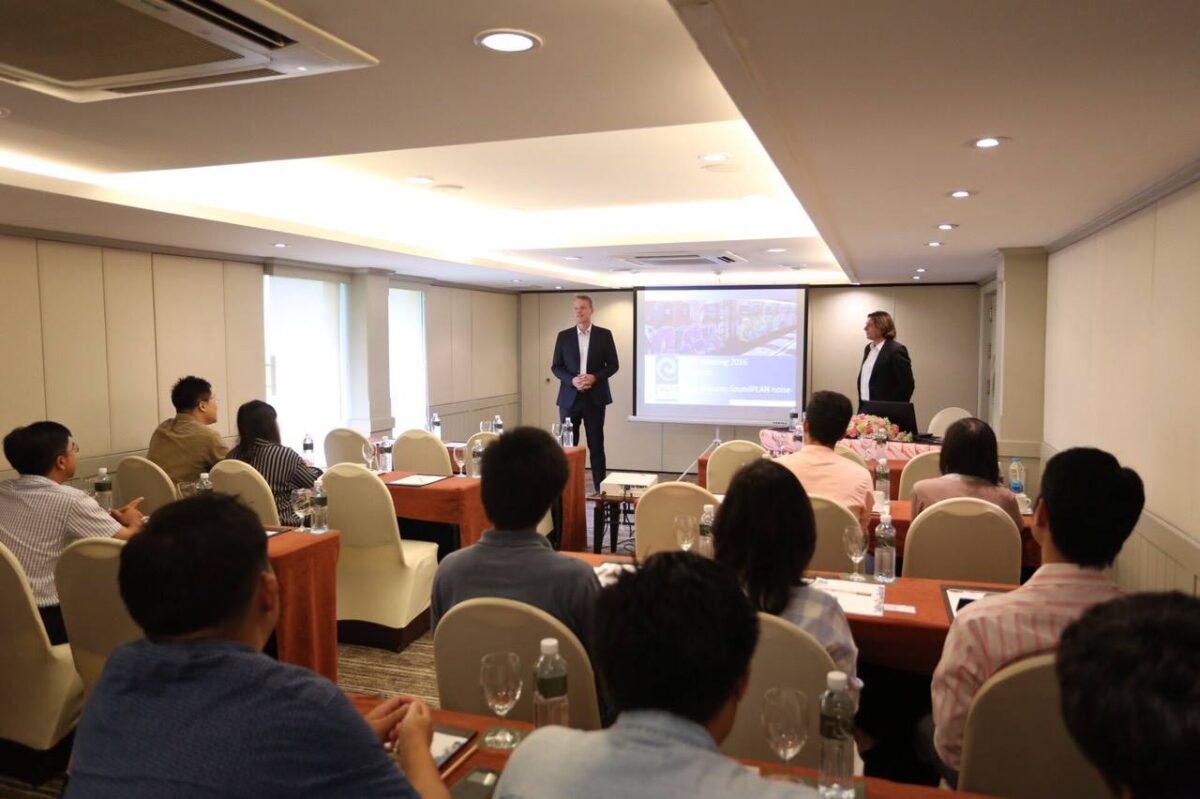
User meeting SoundPLAN, 23 February 2016 Bangkok

User meeting SoundPLAN, 23 February 2016 Bangkok

The SoundPLAN Asia usermeeting will be held in Bangkok, Thailand on 23 February 2016 at the SC Park hotel.

Jochen Schaal is owner / director of SoundPLAN Germany and will tell more about:

– New features SoundPLAN version 7.4
– Industry Industry module new features, Source emission from measured levels, Directivity, Industrial building
– Aircraft Aircraft Noise (radar + helicopter).
– Building Building Acoustics Outside
– Graphics Graphics workshop – new features – questions
– AttributeExplorer, Attribute Explorer and its use
– Total noise VDI 3722-2 total noise assessment
– Loudspeaker Complex loudspeaker setups (d&b audiotechnik)

There will also be a guest speaker from ERTC (Environmental Research and Training Center) who is experienced in noise mapping, especially for the Suvarnabhumi airport extension.

RSVP before 15 February, participation is free for all SoundPLAN users and includes breaks and lunch.

Please send your confirmation to info@soundplan.asia or use our Contact form

 
Categories
Asia Noise News

China Exclusive: Festive noise annoys neighbors

SHIJIAZHUANG, Dec. 9 (Xinhua) — Wu Xianzhou had to eventually call the police because firecrackers that were being set off by his neighbors kept him awake.

“I felt dizzy all day long. Firecrackers woke me at 6 a.m. At 9 p.m., when I tried to sleep, another round of firecrackers went off,” said Wu, who is in his 70s and lives in Xiangfuli Residential Community in the city of Tangshan in Hebei Province.

Noise pollution is a problem, especially at this time of the year. Setting off firecrackers is a Chinese tradition to celebrate weddings, opening of a new business or moving into a new home. Chinese people tend to arrange wedding ceremonies at the end of the year.

Although cities including Tangshan do not allow firecrackers to be set off in the city proper, enforcement is poor. Police usually turn a blind eye.

People realize the harm being caused to their health by the noise. They have complained about it, said You Jie, a police officer in the city’s Lubei District.

You said his police station in Wenhua Road has dealt with nearly 1,000 complaints about firecrackers this year. The police have issued fines in extreme cases.

Studies show that noise exceeding 85 decibels can cause hearing impairment and harm the heart. Long-term exposure to noise may lead to male infertility or miscarriage.

Apart from firecrackers, loud music in public squares is also a problem.

Last month, high school students from the No. 1 High School of Kailuan in Tangshan City protested about loud music being played in Fenghuangshan Park, a place where people dance.

They wore t-shirts saying “Dear grandpas and grandmas, uncles and aunts, would you please put your music down. We’re having lessons. Bless you. Thank you.”

Liu Sichen, one of the protesters, said although the dancing created a harmonious atmosphere, it was too loud. The noise made it difficult for the students to concentrate in class.

“The dance music drowned out our teacher’s voice,” he said.

In response, dancers decided to use smaller audio amplifiers so the music is not as loud.

To address noise pollution, authorities in Tangshan, Taiyuan, capital of Shanxi Province, and Guangzhou, capital of Guangdong Province, are mulling the idea of a “noise map”, where different areas can have different noise limits.

“With the mapping, both complaints and enforcement regarding noise pollution will be better exerted based on regulations,” said police officer You.

Categories
Asia Noise News

Hong Kong blind community calls for louder noise from electric cars to improve safety

Hong Kong blind community calls for louder noise from electric cars to improve safety

Hong Kong blind community calls for louder noise from electric cars to improve safety

The silent nature of electric cars may improve quality of life, but Hong Kong’s blind community has demanded the city’s e-vehicles emit a louder noise, claiming their quietness threatens the safety of the visually impaired, the Post has learned.

Joining forces with the World Blind Union’s global campaign against silent e-cars over safety risks, the Hong Kong Blind Union has raised calls for local authorities to introduce legislation to regulate the vehicles.

Concerns have been raised by the international blind community about their hazards as they give no audible warnings to road users. This risk is higher when silent cars proceed at low speeds such as in parking lots.

As some countries such as the US, the UK and Japan already have plans to regulate e-cars’ sound levels, the union hoped local officials would require the city’s e-cars to be equipped with an alert system so that not only the visually impaired but also the elderly and children could easily be alerted to their movements, particularly on quiet roads. As of the end of August this year, there were 6,167 electric vehicles in Hong Kong, up from fewer than 100 at the end of 2010.

The union’s president Chong Chan-yau told the Post his group wrote a letter to the government in March this year asking that it introduce legislation and conduct a public consultation with all stakeholders, especially the blind community. “But the reply to us did not indicate any active actions to be taken by the government,” he said.

“E-cars are now being regarded as a potential threat to visually-impaired pedestrians. The World Blind Union has raised this issue over the past two years at the UN and the European Union. This battle is being fought internationally,” he added.

A Transport and Housing Bureau spokesman told the Post it would follow up the issue as the UN Economic Commission for Europe world forum for the harmonisation of vehicle regulations was soon to publish a regulation requiring acoustic warning devices on hybrid and electric cars.

Once the regulation is published, the department will “liaise with the electric-vehicles’ manufacturers to follow up on installing acoustic warning systems on their vehicles” to further safeguard road users, the spokesman said.

He added the department had tried to persuade the relevant suppliers in Hong Kong to install the alert system to address blind people’s concerns, believing they would follow the new regulation.

He said some e-vehicles’ manufacturers such as Nissan Leaf and Renault Zoe had “already taken the initiative to introduce such systems into certain EV models in Hong Kong”.

But Chong said regulation of e-cars’ warning devices was necessary as the blind relied heavily on surrounding noise for orientation and discerning between vehicular and pedestrian roads.

He added that while many manufacturers agreed to install a warning system in their e-cars, some would like to give drivers an option to turn off the sound. Chong cited views he gathered at a World Blind Union conference in Orlando, Florida, in August.

“This is unacceptable to us. For the drivers, it doesn’t affect them because the sound is emitted outside the car, not inside. We will insist that the system should always be turned on,” he said.

Locky Law, Tesla owner representative at Charged Hong Kong, said e-car owners would not oppose installing a beeper if carmakers sought to use the device to address blind people’s concerns.

However, he expressed worries over noise emission levels as the city’s streets were already clattering with different types of sounds. Law said adding beepers to e-cars and requiring them to emit a sound whenever they moved would “certainly make the roads very noisy”.

“How loud should the beeper be then?” he asked. “With so many sounds on the roads, will that be even more confusing and dangerous for the blind?”

Law said the best approach was to conduct joint tests on Hong Kong streets with participation from representatives from blind groups as well as the government, academic experts and automakers to determine what noise standards would be suitable locally.

A spokesman for carmaker Honest Motors, which produces the Nissan Leaf, said the company’s e-cars had been equipped with beepers since 2011 in compliance with US regulation.

“The sound is loud enough to provide a warning to road users and quiet enough to avoid being disturbing,” he said. “Since the noise is emitted from outside [the vehicle], it still enables a quiet environment inside.”

Source: https://www.biv.com

Thailand